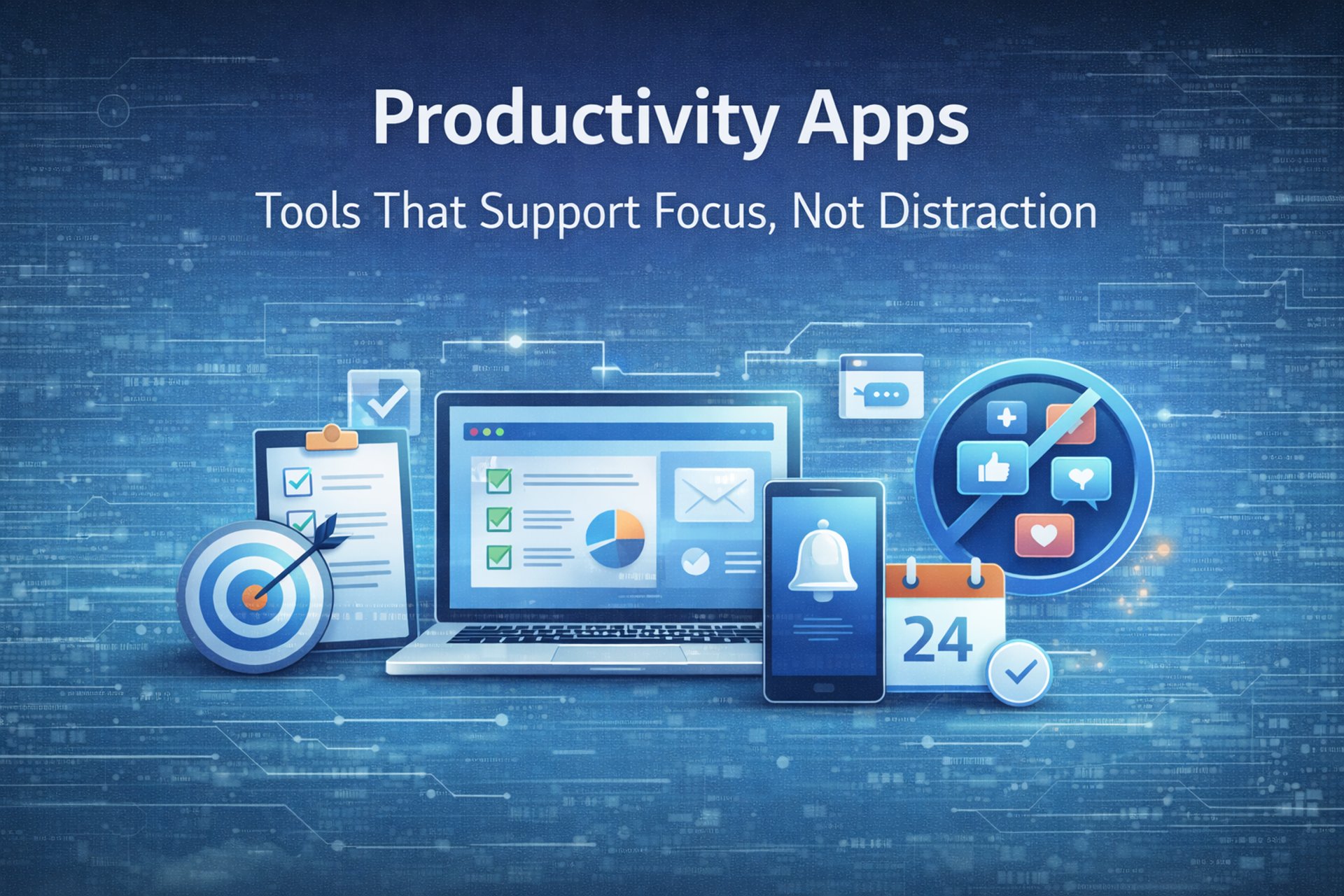
Productivity apps promise better focus, faster work, and improved output. In practice, many of them do the opposite, adding notifications, complexity, and constant switching. This page exists to help you think clearly about productivity tools, so they support how you work instead of competing for your attention.
Why Productivity Apps Matter
Modern work relies heavily on digital tools to manage tasks, time, communication, and information. When chosen carefully, productivity apps reduce mental load and make work easier to manage. When chosen poorly, they fragment attention and increase cognitive effort.
Good productivity tools:
Reduce decision fatigue
Support consistency
Make progress visible
Stay out of the way once set up
The goal is not to do more, but to work with less friction.
The Real Problem: Productivity Tools Create Work of Their Own
Many people adopt productivity apps to gain control, only to spend more time managing the tools themselves.
Common issues include:
Too many task managers for the same work
Over-engineered systems that are hard to maintain
Constant switching between apps
Notifications that interrupt focus
Tools that require daily “maintenance” to stay useful
When tools demand attention, they stop being productivity tools.
Productivity Is a System, Not an App
No single app can make someone productive. Productivity comes from systems that align with how work actually happens.
Effective tools:
Match natural work habits
Support simple routines
Allow flexibility instead of rigid rules
Help you prioritize, not overload
An app should reinforce good behavior, not attempt to replace it.
Simplicity Scales Better Than Complexity
Many productivity apps fail as workload increases. Complex setups break under pressure, while simple systems remain usable.
In practice:
Fewer tools outperform large stacks
Clear workflows beat advanced features
Consistency matters more than customization
The best productivity tools are often the ones you forget about while working.
How AskTechDigital Covers Productivity Apps
AskTechDigital approaches productivity from a practical, human perspective.
Here, productivity apps are evaluated based on:
Real-world usability
Long-term sustainability
Impact on focus and clarity
How well they integrate into daily work
The focus is on supporting work, not optimizing for perfection.
Who This Page Is For
This page is for:
Individuals trying to regain focus
Professionals managing complex workloads
Teams looking to reduce tool overload
Anyone rethinking their productivity setup
This is not for:
Extreme optimization culture
Over-engineered systems
Productivity for productivity’s sake
Where to Go Next
Explore AskTechDigital’s guides and breakdowns to understand which productivity apps actually help, which ones create friction, and how to build a setup that lasts.
Productivity is not about doing more; it’s about working better.
HELP
Questions, feedback, or corrections?
Reach us anytime. AskTechDigital is built on clarity and accuracy.
Contact
Stay Connected
contact@asktechdigital.com
© 2025 Ask Tech Digital. All rights reserved.
Get occasional updates on AI tools, software reviews, and digital insights.
No spam. Unsubscribe anytime.
ABOUT
AskTechDigital is an independent editorial platform focused on clarity in technology, software, and digital decision-making. Learn more about our approach.